Manila, Philippines
info@sportstek.ph

Other Sports
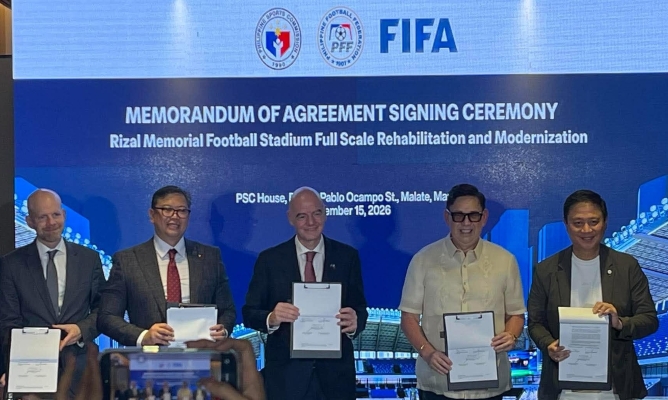
FIFA, PFF, and PSC signs deal to rehabilitate historic Rizal Memorial Stadium
For nearly a century, the Rizal Memorial Stadium has stood at the heart of Philippine sport, its Art Deco façade witnessing the triumphs, heartbreaks, and aspirations of generations of Filipino athletes.
Opened in 1934 and built as the centerpiece of the Rizal Memorial Sports Complex, the stadium is more than concrete, steel, and turf.
It is a living monument to Philippine football history, a venue where the nation's sporting identity has unfolded before packed grandstands and international audiences.
Today, that history prepares to embark on a remarkable new chapter.
Following the Philippines' successful hosting of the inaugural FIFA Women's Futsal World Cup in 2025, FIFA President Gianni Infantino will channel nearly US$20 million (roughly P1.275 billion) into the redevelopment of the Rizal Memorial Football Stadium and the construction of three regional football training centers across the country at no cost to the Philippine government.
Infantino will sign this landmark agreement with Philippine Sports Commission Chairman Patrick Gregorio and Philippine Football Federation President John Anthony Gutierrez on Sunday at the PSC House in Manila in a transformative investment that links Philippine football's proud past with an ambitious future.
The stadium opened in 1934 for the 10th Far Eastern Championship Games, then Asia's premier sporting competition and a precursor to the Asian Games.
Designed by renowned architect Juan Arellano, whose Art Deco masterpieces include the Manila Metropolitan Theater and the Old Legislative Building, the stadium immediately became one of Southeast Asia's most impressive sporting venues.
Its first football matches featured the leading national teams of the era: China, Japan, the Dutch East Indies, and the Philippines. Historical records show crowds of up to 40,000 spectators attending matches during the 1934 Far Eastern Games, underscoring football's popularity in pre-war Manila.
The venue survived war, reconstruction, and political change. Damaged during the Battle of Manila in 1945, it was rebuilt and restored to become the centerpiece of Philippine sports once again.
For Filipino fans, the most beloved figures to grace the venue were the heroes of the "Azkals" era.
Players such as Phil Younghusband, the country's all-time leading scorer, his brother James Younghusband, Neil Etheridge, Stephan Schrock, Misagh Bahadoran, and Angel Guirado helped transform Rizal Memorial into a fortress during the Philippine football renaissance of the 2010s.
The women's national team also created memorable moments here, with generations of Filipinas using the historic ground as a platform for the country's rise in women's football.
While various improvements have taken place over the years, the stadium's most significant modernization before the new FIFA-funded project came in preparation for the 2019 Southeast Asian Games.
The venue received extensive upgrades, including improvements to the playing surface, grandstand facilities, athlete areas, lighting, and spectator amenities to bring it closer to international standards.
Recognizing the country's contribution to FIFA's growth and the tournament's success, Infantino approved nearly US$20 million in funding that will dramatically reshape Philippine football infrastructure.
Under the agreement signed by FIFA, the PSC, and the PFF, Rizal Memorial Football Stadium will undergo its most ambitious redevelopment since its opening in 1934.
When completed, the full-scale rehabilitation and modernization of the venue will feature a 25,000-seat capacity, state-of-the-art football facilities, modern spectator amenities, a permanent home for the Philippine Football Federation and infrastructure capable of hosting major international competitions.