Manila, Philippines
info@sportstek.ph

Motoring
From AI to Electric Vehicles: VinFast 2026 Summit looks at Future of Mobility
By Marielle Reyes
NHA TRANG, Vietnam — Advances in artificial intelligence, autonomous driving and connected vehicle technology are reshaping the automotive industry, creating new opportunities and challenges for manufacturers worldwide. As these technologies become increasingly integrated into modern vehicles, automakers are also facing new demands in innovation, safety and accessibility.
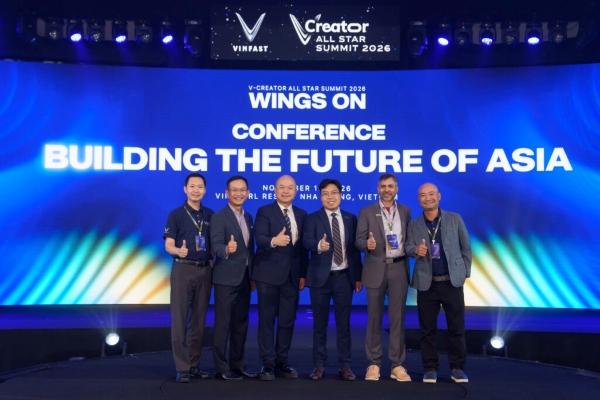
These developments formed the backdrop of the V-Creator All Star Summit 2026, where VinFast and its parent group, Vingroup, brought together technology executives, business leaders and international media to discuss the future of mobility.
Held at Vinpearl Resort Nha Trang under the theme “Building the Future of Asia,” the November 17 conference featured speakers from Qualcomm, academia and VinFast. Journalists, content creators and automotive communities from India, Indonesia and the Philippines also attended. The conference was part of a five-day program involving more than 500 international participants, with activities covering technology discussions, industry exchanges and experiences across the Vingroup ecosystem.
Global expertise on AI and mobility
The conference opened discussions on the growing influence of artificial intelligence in automotive development, featuring perspectives from international technology and academic leaders.
With leading voices from artificial intelligence, automotive technology and international business, the Vietnam-hosted gathering signals a broader ambition: to build a global platform for industry dialogue, knowledge exchange and Asia’s growing role in shaping the future.
Professor Toby Walsh, a leading AI researcher and Scientia Professor at the University of New South Wales in Australia, examined how artificial intelligence is transforming industries. In his session, “From AI to the Future of Mobility: How Intelligence Is Reshaping Industries,” he discussed how businesses can translate AI advancements into practical applications. He also explored the commercial opportunities emerging from the technology.
Abhay Rai, Vice President of ADAS Product Management at Qualcomm, shifted the discussion toward the development of intelligent driving systems. His presentation covered the evolution of advanced driver assistance systems (ADAS) and automated driving, including the role of AI, high-performance computing and software-defined vehicle architectures. He also addressed the challenge of making these technologies safer, more reliable and accessible across different vehicle segments. Together, the presentations highlighted the need to turn technological breakthroughs into practical and commercially viable solutions.
VinFast outlines its electric mobility strategy
Alongside the international perspectives, VinFast executives discussed the company’s development as an electric vehicle manufacturer and its approach to expanding into global markets.
Tapan Ghosh, CEO of VinFast Asia, traced the company’s growth from a Vietnamese automaker into an international electric mobility brand. His presentation focused on making electric vehicles more accessible to mainstream consumers. He highlighted affordability, charging infrastructure, ownership policies and after-sales services as important factors in encouraging wider adoption.
The discussion also covered VinFast’s work in intelligent vehicle technologies. Professor Dr. Van Duong Nguyen, a senior VinFast executive specializing in advanced driver assistance and autonomous driving technologies, presented the company’s developments in Level 2 and Level 2+ driver assistance systems. He also discussed emerging approaches involving end-to-end AI, Vision-Language-Action models and Agentic AI. These developments involve technical considerations ranging from computing requirements and data availability to vehicle performance and safety.
Asia’s growing electric vehicle market
Beyond vehicle technology, the summit examined the opportunities and challenges shaping electric mobility across Asian markets.
Ghosh and Antonio “Toti” Zara, CEO of VinFast Philippines, shared perspectives on the company’s regional expansion, highlighting the potential of India, Indonesia and the Philippines. While these markets offer considerable opportunities for EV adoption, each has different infrastructure requirements, regulatory environments and consumer preferences. These differences make localized strategies essential to the development of electric mobility.
Vehicle distribution, charging networks, customer experience and after-sales support remain important considerations in expanding EV adoption. The discussions emphasized that the transition to electric mobility will depend on more than advances in vehicle technology. Accessible infrastructure and reliable support services will also play a role in making electric vehicle ownership practical for consumers.
Vingroup expands its role in global technology discussions
Beyond its technical presentations, the summit highlighted Vingroup’s ambition to contribute to wider conversations on technology, business and mobility.
By bringing together international researchers, technology executives and media representatives, the event provided a platform for discussions extending beyond conventional automotive launches and product demonstrations. Its format also reflects how automotive media engagement is evolving, giving journalists and content creators greater access to industry specialists and developments across artificial intelligence, software, energy and vehicle technology.
Hosting the summit in Vietnam also highlighted the country’s role as a venue for international discussions on innovation and emerging technologies. The V-Creator All Star Summit 2026 could also serve as the foundation for a recurring forum connecting automotive and technology leaders, researchers and media professionals.
As electric vehicles, artificial intelligence and connected technologies continue to reshape transportation, collaboration among automakers, technology companies and research institutions will become increasingly important. Through V-Creator, VinFast and Vingroup are seeking to contribute to these developments while bringing together industry perspectives on the future of mobility.